English & Movies - Aprender inglés con películas
Learn with 2001: A SPACE ODYSSEY
En esta parte, analizamos extractos de guiones de películas para entender el uso del inglés cotidiano auténtico. Lee los fragmentos e intenta comprenderlos. Luego, lee la explicación del vocabulario. Finalmente, vuelve a leer el texto.
Recomendaciones para aprender inglés
con películas
1. Elige escenas cortas, retrocede y vuelve a mirarlas para tratar de entenderlas.
2. Desactiva los subtítulos en español. Si aún no logras entender el diálogo, activa la opción "CC" (Closed Caption) en tu televisor para ver los subtítulos en inglés.
3. Intenta mirar películas que conozcas y hayas visto. Dado que ya sabes lo que sucede en la trama, podrás concentrarte en el vocabulario y las expresiones usadas en las conversaciones.
4. Repite las frases que escuchas y si no entiendes algo, utiliza un diccionario.
5. Presta atención a la pronunciación y la entonación. De esta forma, irás entrenando el oído para identificar las palabras, lo cual ciertamente te ayudará a mejorar tu comprensión del inglés.
 MILLER: Oh, good morning, Dr. Floyd. I'm Nick Miller.
FLOYD: How do you do, Mr. Miller?
MILLER: I'm terribly sorry. I was just on my way down to meet you. I saw your ship dock and I knew I had plenty of time, and I was on my way out of the office when, suddenly, the phone rang.
FLOYD: Oh, please don't worry about it.
MILLER: Well, thank you very much for being so understanding.
FLOYD: Please, it really doesn't matter.
MILLER: Well.. Did you have a pleasant flight?
FLOYD: Yes, very pleasant.
MILLER: Well, shall we go through Documentation?
FLOYD: Fine.
| Good morning | Buenos días. 'Buenas tardes' se dice 'Good afternoon'. Para decir 'Buenas noches' existen dos formas: 'Good evening', para saludar a alguien cuando se llega o cuando se deja un lugar y 'Good night', que se usa cuando uno se va a dormir. |
| How do you do | ¿Cómo está/s? Este es un saludo formal. En términos más familiares podría decirse 'How are you doing?' o más informalmente todavía, 'How's it going?'. |
| I'm terribly sorry | lo siento mucho |
| on my way down | bajando. Notar el uso de la expresión on my way para indicar la dirección hacia la cual se dirige. |
| dock | Como verbo significa atracar (un barco), acoplar (una nave espacial). Como sustantivo significa muelle, dársena. Pero en plural, docks significa puerto. |
| plenty of time | suficiente tiempo, mucho tiempo |
| on my way out of | saliendo de |
| suddenly | de pronto, de repente |
| to worry about something | preocuparse por algo. Notar el uso de la preposición about. |
| to thank somebody for something | agradecer a alguien por algo. Notar que no hay ninguna palabra entre el verbo y la persona. Notar el uso de la preposición for. |
| understanding | comprensivo |
| it doesn't matter | no importa, no interesa |
| a pleasant flight | un viaje placentero |
| shall we...? | Es una forma de hacer una sugerencia en la que la persona que habla está incluída. Por ejemplo, 'Shall we go to the cinema?' equivale al español '¿Vamos al cine?' |
| to go through something | pasar por algún lugar. En este caso se refiere a pasar por la sección Documentos. Por ejemplo, cuando se llega al aeropuerto, se pasa por la aduana, to go through customs. |

ELENA: How nice to see you, Hyewood. This is my good friend, Dr. Heywood Floyd. I'd like you to meet Andre Smyslov... And this is Dr. Kalinan... Stretyneva...
SMYSLOV: Dr. Floyd, won't you join us for a drink?
FLOYD: I'm afraid I've only got a few minutes, but I'd love to.
SYMYSLOV: What would you like to drink?
FLOYD: Oh, I really don't have time for a drink. If it's all right I'll just sit for a minute and then I've got to be off.
SMYSLOV: Are you quite sure?
FLOYD: Yes, really, thank you very much.
ELENA: Well... How's your lovely wife?
FLOYD: She's wonderful.
ELENA: And your charming little daughter?
FLOYD: Oh, she's growing up very fast. As a matter of fact, she's six tomorrow.
ELENA: Oh, that's such a delightful age.
FLOYD: How is Gregor?
ELENA: He's fine. But I'm afraid we don't get a chance to see each other very much these days.
| How nice to see you again | Que bueno es verte otra vez |
| I'd like you to meet... | Me gustaría que conozcas a... Es una forma de presentar a alguien frente a otra persona. |
| Won't you...? | Es una manera informal de hacer una sugerencia o invitar a alguien a hacer algo. Por ejemplo, 'Won't you come to the cinema with us?' equivale al español '¿No vendrías al cine con nosotros?' |
| to join somebody for something | unirse a alguien para algo. En este caso, 'join somebody for a drink' significaría 'ir con alguien por un trago'. |
| What would you like to drink? | ¿Qué le gustaría beber? Es una forma cortés de ofrecer algo a alguien. |
| to have time for something | tener tiempo para algo. Notar el uso de la preposición for. |
| to be off | irse |
| charming | encantador/a |
| to grow up | crecer |
| as a matter of fact | de hecho, en realidad |
| delightful | encantador/a |
| I'm afraid... | Me temo que... |
| to get a chance to do something | tener oportunidad de hacer algo |
FLOYD: I'm sorry, but I'm not sure I know what you mean.
SMYSLOV: Well, it's just for the past two weeks there have been some extremely odd things happening at Clavius.
FLOYD: Really?
SMYSLOV: Yes. Well, for one thing, whenever you phone the base, all you can get is a recording which repeats that the phone lines are temporarily out of order.
FLOYD: Well, I suppose they've been having a bit of trouble with some of the equipment.
SMYSLOV: Yes, well, at first we thought that was the explanation, but it's been going on for the past ten days.
FLOYD: You mean you haven't been able to get anyone at the base for ten days?
SMYSLOV: That's right.
FLOYD: I see.
ELENA: Another thing, Heywood, two days ago, one of our rocket buses was denied permission for an emergency landing at Clavius.
| inquisitive | curioso, inquisidor |
| to clear up | aclarar |
| to go on | suceder |
| up there | allí arriba |
| odd things | cosas extrañas. Para aprender otras formar de decir 'raro o extraño' ver Ways of saying strange. |
| for one thing | en primer lugar, para empezar, entre otras cosas |
| out of order | fuera de servicio |
| a bit of trouble | algunos problemas. Como trouble es incontable, es necesario usar la frase a bit of para referirse a algunos problemas. |
| for the past ten days | durante los últimos diez días |
| two days ago | hace dos días |
| to deny permission | denegar permiso. También suele escucharse la frase permission denied que significa 'permiso denegado'. |
| emergency landing | aterrizaje de emergencia |
COPILOT: Well, I've heard more and more people talk of an epidemic.
PILOT: I suppose it was bound to happen sooner or later.
COPILOT: Berkeley told me that they think it came from contamination on a returning Mars flight.
PILOT: Yes, well, whatever it is, they're certainly not fooling around. This is the first flight they allowed in for more than a week.
COPILOT: I was working out what this trip must cost, taking him up there by himself and coming back empty.
PILOT: I'll bet it's a fortune.
| I wonder... | Me pregunto... Es una forma de introducir una duda. |
| more and more people | más y más gente |
| epidemic | Como sustantivo, significa epidemia. Como adjetivo, significa epidémico. |
| to be bound to | ser seguro que. Por ejemplo, Tom is bound to come significa 'Seguro que Tom viene'. It is bound to rain today significa 'Seguro que hoy llueve'. |
| sooner or later | tarde o temprano |
| to come from something | venir de algo, originarse por algo |
| on a flight | en un vuelo. Notar el uso de la preposición on. |
| whatever it is | lo que fuera |
| to fool around | perder el tiempo neciamente |
| for more than a week | por más de una semana |
| to work out something | calcular algo |
| by himself | solo. La construcción es by + pronombre reflexivo. Por ejemplo, by myself, by ourselves, by themselves. |
| to bet | apostar |
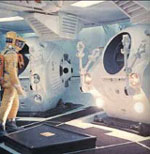 POOLE:
Good morning.
POOLE:
Good morning.BOWMAN: Good morning. How's it going?
POOLE: Are you reasonably awake?
BOWMAN: Oh, I'm fine, I'm wide awake. What's up?
POOLE: Well... Hal's reported the AO-unit about to fail again.
BOWMAN: You're kidding.
POOLE: No.
BOWMAN: What the hell is going on?
POOLE: I don't know. Hal said he thought it might be the assembly procedure.
BOWMAN: Two units in four days. How many spares do we have?
POOLE: Two more.
BOWMAN: Well, I hope there's nothing wrong with the assembly on those. Otherwise we're out of business.
| how's it going? | ¿Cómo te va? Es un saludo informal. |
| wide awake | completamente despierto. La forma opuesta es fast asleep o sound asleep, profundamente dormido. |
| what's up? | ¿Qué pasa? |
| about to fail | a punto de fallar |
| you're kidding | estás bromeando |
| what the hell...? | ¿Qué demonios...? |
| assembly procedure | procedimiento de montaje |
| spare | de repuesto, extra. Por ejemplo, a spare tyre es la rueda de auxilio, a spare pen es una lapicera de repuesto, spare time significa tiempo extra. |
| otherwise | de lo contrario |
| to be/go out of business | quebrar |
- ALADDIN
- GLADIATOR
- NOTTING HILL
- SHREK
- TITANIC
- TOY STORY
Ver todas las películas
The scripts and the images are copyright.
They are used here for educational purposes only.
Otras páginas que pueden interesarte


 Aprende y memoriza nuevas palabras de forma amena!
Por temas, con imágenes y ejemplos de uso.
Listas de Vocabulario
2001: A Space Odyssey
Practique su inglés leyendo la novela original
Descubre el origen de las palabras en
The Story behind the Words
 Aprende inglés con las letras de tus canciones favoritas, con el análisis del vocabulario y la traducción al español. ¡Fácil y divertido!
Ingresa en English & Songs.
 Practica comprensión auditiva (listening comprehension) con noticias de la actualidad.
Listening
Practica comprensión auditiva (listening comprehension) con noticias de la actualidad.
Listening